Routernitro USDC transfers
Router Protocol’s bridge, Router Nitro, used Circle’s Cross-Chain Transfer Protocol (CCTP) for native USDC transfers. The February 28, 2024 CCTP integration required Circle attestation after the source burn and before destination minting. Fast Nitro transfers used forwarder liquidity.
Updated:
- Documented chains
- Polygon, Optimism, Arbitrum, Ethereum, Base and Avalanche in the February 28, 2024 integration announcement. Both participating chains needed support for that CCTP path.
- Historical routing threshold
- Router’s February 28, 2024 announcement described a CCTP default for Nitro transfers strictly above 5 000 USDC between supported chains.
- Recipient handling
- Nitro supplied the user’s address during the source burn. The forwarder did not specify the recipient again when triggering destination minting.
- Operating context
- CoinGabbar’s September 5, 2026 report described Router Protocol’s planned full wind-down by September 30, 2026. That planned closure does not establish current route availability or an individual transfer’s outcome.
Source execution and destination receipt
Nitro’s documented CCTP flow began with the user authorizing and submitting a call to its source-chain contract. Nitro then initiated a CCTP burn of the specified transfer amount. The initiating request and the source burn represented separate milestones.
A forwarder watched for the burn event and polled Circle’s API until it obtained an attestation. After receiving that attestation, the forwarder relayed the attested burn message to the destination CCTP contracts, which triggered USDC minting to the user’s address.
The source burn established destruction of USDC on the originating chain; the destination mint established receipt on the receiving chain. Reconciliation connects the source burn to its corresponding destination mint, including the destination chain, the user’s recipient address and the USDC amount.
CCTP and fast Nitro delivery
Fast Nitro transfers used Nitro liquidity, while CCTP transfers minted destination USDC after source burning and Circle attestation. Router’s February 2024 announcement described CCTP transfers as taking slightly longer than fast Nitro transfers. It supplied a relative comparison without a fixed completion time.
Destination minting and a fast-path destination payout represent comparable delivery milestones. Comparing a CCTP source burn with a fast-path payout mixes source execution with destination delivery.
The historical 5 000 USDC threshold selected a default route; it did not specify a minimum CCTP transfer. Router’s later CCTP V2 announcements included native-USDC support for Linea, World Chain and Unichain. Those later announcements did not establish that the February 2024 size rule governed the V2 routes.
Burned USDC without a destination mint
A source burn without Circle attestation had not reached the prerequisite for the documented destination call. The forwarder continued polling Circle’s API during that waiting interval. Receiving an attestation still left destination execution as a separate step; attestation alone did not establish receipt.
A missing destination mint alone does not reveal whether Circle attestation remains outstanding or destination execution has yet to finish.
Decision checklist
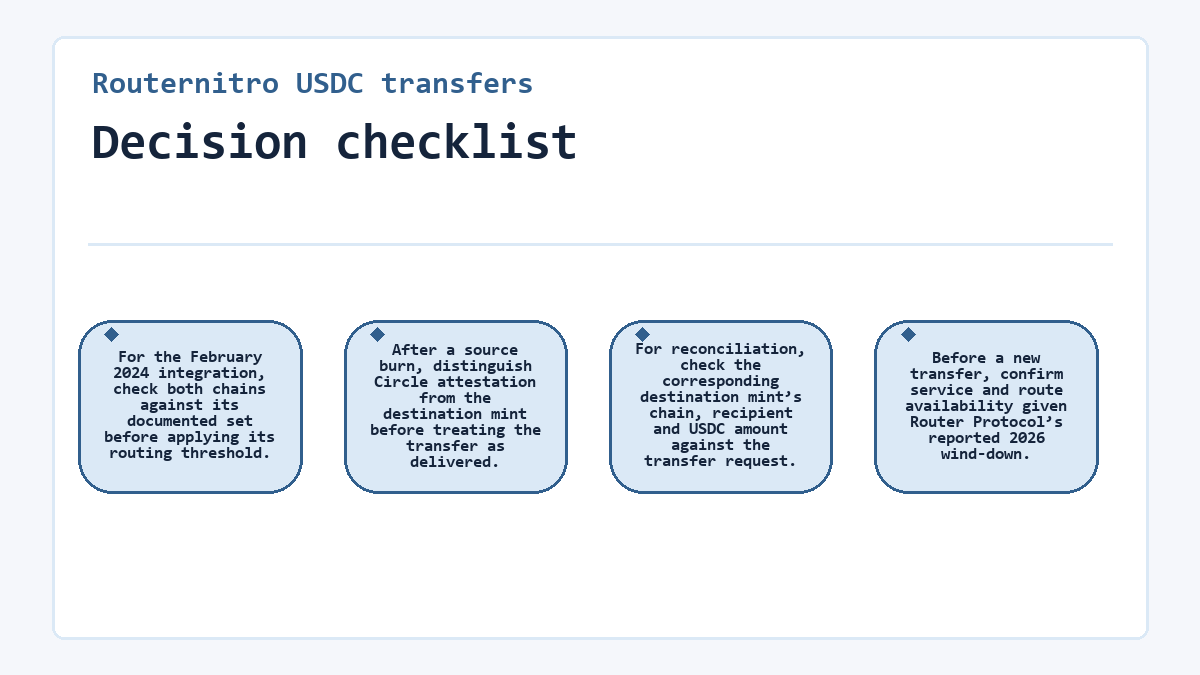
- For the February 2024 integration, check both chains against its documented set before applying its routing threshold.
- After a source burn, distinguish Circle attestation from the destination mint before treating the transfer as delivered.
- For reconciliation, check the corresponding destination mint’s chain, recipient and USDC amount against the transfer request.
- Before a new transfer, confirm service and route availability given Router Protocol’s reported 2026 wind-down.