Routernitro: Burn-and-Mint Requirements
Router Protocol’s November 2023 documentation described a token-specific burn-and-mint path for its cross-chain bridge, Router Nitro. This path required token permissions on both participating chains so Nitro could burn source tokens before minting destination equivalents.
Updated:
- Design reference
- Router Protocol’s The Intricacies of Cross-Chain Transfers and Router Nitro , published November 22, 2023.
- Operating context
- CoinGabbar reported on September 5, 2026 that Router Protocol planned to end all operations by September 30, 2026. That report gave a planned deadline; it did not confirm completed closure or present route availability.
Token permissions and transfer parameters
| Parameter | Documented value | Where it applies | Permission and settlement conditions |
|---|---|---|---|
| Token rights | Mint/burn permissions for the particular token | Source and destination chains | The bridge needed the relevant permissions on both participating chains. |
| Source operation | Request validation, token collection and burning | Source-chain Nitro contract | Source burning preceded destination minting. |
| Validation threshold |
2/3+1
|
Router Chain | Orchestrators attested to the source burn before middleware processing. |
| Transfer-fee treatment | Middleware deducted fees from funds going to the user. | Nitro middleware on Router Chain | The fee deduction preceded destination minting. |
| Forwarder fee | None for this burn-and-mint path | The documented token-permission flow | Forwarders did not advance destination liquidity for this path. |
| USDC alternative | Circle CCTP | Chains where CCTP operated | The separate 2023 USDC flow used Circle attestations before destination minting. |
From source burn to destination mint
Router Protocol’s November 22, 2023 transfer-design article described the source Nitro contract validating a request and burning the collected tokens. Its
iSend()
call notified the source Router Gateway. The gateway emitted a burn event, and orchestrators on Router Chain attested to that event.
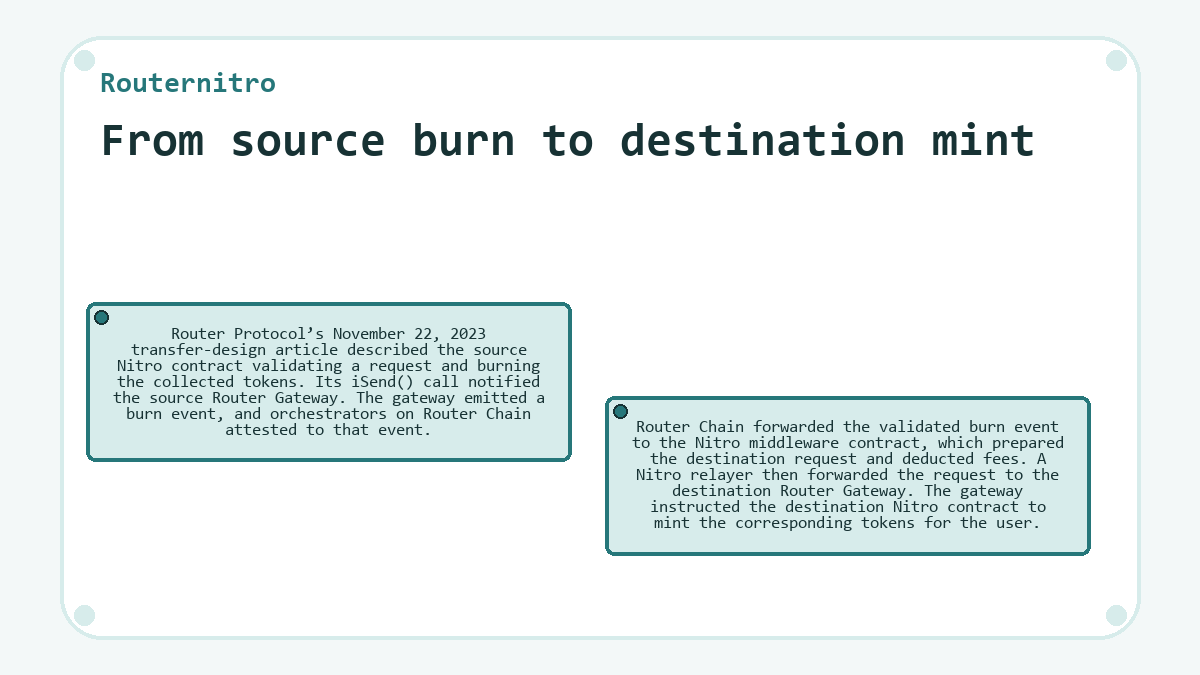
Router Chain forwarded the validated burn event to the Nitro middleware contract, which prepared the destination request and deducted fees. A Nitro relayer then forwarded the request to the destination Router Gateway. The gateway instructed the destination Nitro contract to mint the corresponding tokens for the user.
Burn-and-mint versus forwarder liquidity
Router Nitro’s forwarder flow paid destination assets from a forwarder’s balance before source-side reimbursement. Burn-and-mint created corresponding destination tokens under the token’s permissions, removing that need to advance destination liquidity.
This difference explains why Router Protocol described the burn-and-mint path as having no forwarder fee. The middleware still deducted transfer fees from funds that it prepared for the user. The absence of a forwarder fee therefore did not establish a zero total transfer cost.